Defining Civic Virtue
“Know how to listen and you will profit even from those who talk badly.”

In most of my freshman college classrooms, when I raise the question of civic virtue to my students, I am typically met with a long, vacuous stare followed by the question, “wait, what?” When I offer more specific terms like Truth, Courage, Honesty, and Justice, their eyes brighten, they sit up a bit straighter, and the discussion begins in earnest. They understand what those terms mean, at least in general. The word virtue, however, admittedly has an archaic, Shakespearean tone and it’s with that in mind that I chose to discuss the topic with deliberate and mindful purpose in this first essay. If my droning on about the ancients frightens you, be not dismayed. Future essays will be very modern in both context and application.
In beginning with a discussion of virtue from the point of view of the ancient Greeks and Romans, it is my hope is to provide some foundational knowledge of the classical meaning of virtue and, more importantly, how it served as a guiding light for our nation’s founding; how the Framers of our new government harkened back to the ancient Greeks and Romans and their arguments about the meaning of a good life. Then, to translate that classical meaning into a more modern understanding as alas, not only has it lost its meaning to most Americans, it seems to no longer ground us as citizens. The current ship of state seems to have lost its rudder years ago and is now adrift in a sea of venal partisanship, the politics of personal destruction, and a slide toward authoritarianism. This drift is not a recent phenomenon however. Some tried to sound the alarm. In his first inaugural address in 1993, Bill Clinton sounded an early alarm by way of his description of the state of American politics back then, “Powerful people maneuver for position and worry endlessly about who is in and who is out, who is up and who is down, forgetting those people whose toil and sweat sends us here and pays our way." Now, some 32 years later, if we seek confirmation of Clinton’s words, we need only to examine current social media or cable news sites to witness the rancor and division that has become endemic to our body politic. But before moving forward with defining virtue, it might be best to briefly define the term Body Politic. It refers to the people of a nation, state, or society considered collectively as an organized group of citizens. It is all of us who share in this republic.
So then, the journey to a better understanding of the current state of our body politic is best launched by way of a discussion of those ancient philosophers who charted a path to greater wisdom. As with any journey, we must at least have a rudimentary understanding of basic language to guide our travels. In doing so, we must always remember that the words that defined virtue in the ancient world would help spark more than one revolution and ultimately found their way into our founding documents. The writings of the ancient Greeks and Romans as well as that of early Christian writers, provide abundant discussion and definition of the meaning of virtue. While the Romans tended to be somewhat more opaque about it in their everyday Roman life, the Greeks were thankfully much more specific.
The Greek word for virtue, Arete, forms the foundation of the goal of achieving eudemonia, a flourishing life, a good and purposeful life, and true happiness. For the ancient Greeks, eudemonia can only be achieved by leading a virtuous life, one that has at its foundation, the 5 essential characteristics of wisdom, moderation, temperance, justice, and piety.
Phroensis, the ancient Greek word for wisdom, is the first pillar of a virtuous life. It was, for them, more narrowly defined as practical virtue, implying both good judgment and excellence of character and habits.
Moderation formed the second central pillar to leading a virtuous life in ancient Greece. The phrase, pan metron ariston, or everything in moderation, was to be necessarily applied to every aspect of Greek life. In contrast, their phrase miden aga or nothing in excess was antithetical to achieving eudemonia. This applied to all aspects of life – in politics, ethics, aesthetics, culture, art, architecture, psychology and so on – defiance of which invited hubris, discord and catastrophe and amounted to the repudiation of what the Greeks aspired to more than anything – living with beauty and truth.
The third pillar, Sophrosune, or temperance, refers to that ideal of excellence of character and soundness of mind which, when combined in the well-balanced individual, leads to other qualities, such as temperance, moderation, prudence, purity, decorum, and self-control. Sophrosune is also the virtue of enlightened self-acceptance, of self-knowing. It is a self-acceptance based on an accurate understanding of who one really is, a self-acceptance which results in a humble and settled contentment with the pursuit of one’s destined role in human existence.
For the Greeks, justice, or Dikaiosune, is the fourth pillar leading one to virtue and happiness. For Plato, it is a part of human virtue and the bond which joins man together in society. It is the identical quality that makes good and social. Justice is an order and duty of the parts of the soul. The Greeks felt it was to the soul as health is to the body. Plato says that justice is not mere strength, but it is a harmonious strength. Justice is not the right of the stronger but the effective harmony of the whole. All moral conceptions revolve around the good of the whole individual.
Piety, or Eusebia, is a word that brings up religious images like pious acts of devotion to a religious faith. Piety comes from the Latin Pietas meaning dutiful conduct. Eusebia was how one spoke to their slaves or how a seller would be spoken to as well. It was how one would conduct themselves with the gods in mind. It called for a suitably reverent attitude toward groups and institutions demanding respect and in particular religious institutions that was necessary and essential for the prosperity not only for individuals but for the community as a whole.
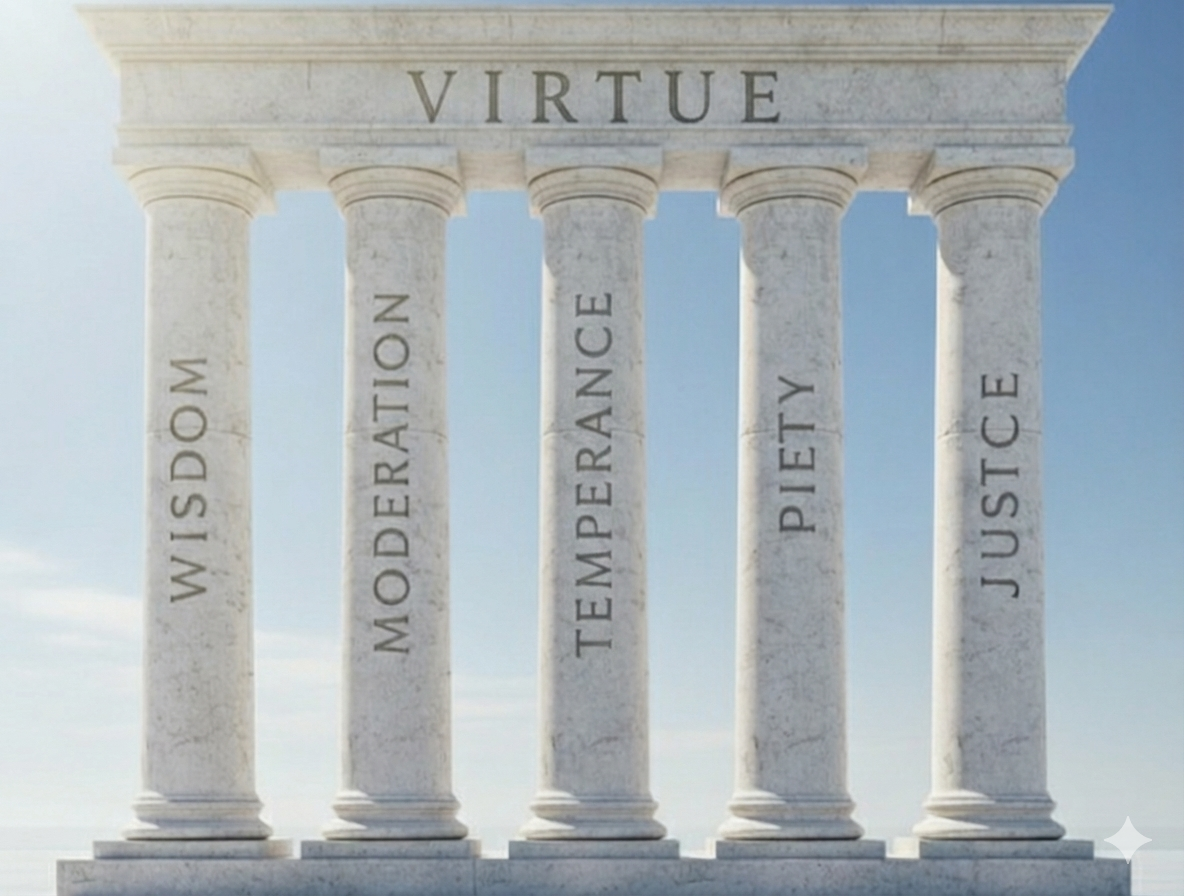
For the ancient Greek, these 5 pillars of virtue were inseparable. It was not possible to pick and choose. They were a collective set of ideals and formed the core of the aspirational life. They were neither subject to interpretation or situational application.
Amidst all this high minded thinking of the ancient Greeks, it is important to point out that everyday life in ancient Greece was not exactly a model of virtue. Ancient Greece was a clearly defined class-based society. Ancient Greece had its propertied class, Aristocracy, aristoi, along with a poorer, second class of property owners, mostly farmers living outside the Greek cities, perikoi. There existed what we would call a middle class, even a nouveau riche, mostly comprised of artisans and traders who moved up in social class, and who might have been slaves themselves at one time. As was the case in most ancient societies, there was a sizeable slave class, douloi, who worked in some 200 occupations and could even perform some civil and military duties and also some semi-free laborers such as the helots of Sparta. Women, of course, had no citizen rights and the same was true for foreigners.
To the modern observer, it would be easy to view this hierarchical societal structure as undemocratic, discriminatory, and perhaps even hypocritical. Seen through the lens of the ancient world and remembering that history is, after all, a study of people and events in their context, I think it’s fair to say that the ancient Greeks were an aspirational people and while class movement was limited to some and prohibited to most, higher ideals seemed to dwell in the heart of most of the ancient Greeks. Perhaps, the great philosophers of ancient Greece had a vision for their society, and maybe all human society, not as it was, imperfect and often brutal, but as it should be and what it could and should become. We will see that aspirational thread emerge in a later examination of the American experiment as it begins, in the calling to our better angels some 70 years later, and now in our most current crisis.

If the Greeks began the discussion about virtue, it was the Romans who brought it to the larger ancient world. Thoughts of Roman society bring to mind color and pageantry, warriors mounted on noble steeds engaged in battle and conquest, benevolent oppressors of enslaved peoples. It is the stuff of Hollywood epics. The more ignored aspect of Roman culture is the role their civilization played in defining, and for living out, for the most part, the true meaning of virtue. Certainly, the founders of our early United States used the Romans as their intellectual anchor for their revolution. But that discussion is best left for later essays. For now, let’s examine the Roman definition of virtue.
The importance of virtue to the Roman cultural identity is eloquently emphasized by their statesman Cicero, “Cling fast to virtue (virtus), I beg you men of Rome, it is a heritage that your ancestors bequeathed you. All else is false and doubtful, ephemeral and changeful; only virtue stands firmly, its roots run deep, it can never be shaken by any violence, never moved from its place.” This then, is the declaration of the aspirational Roman argument for virtue. Like our society today, they most certainly were not perfect but rather striving to be virtuous. The list of Roman virtues that follow served as their guide to a more perfect Roman society. They functioned as a set of expectations that, as part of ongoing self-reflection, permeated all aspects of Roman life. If the goal was a more happy, productive, honorable and fulfilling life, then virtues would mark the way. Even with the pervasive nature of Roman law, it was more an expectation of the Roman privileged class that they would model these virtues. This was best expressed by the Roman Philosopher Pliny, “We need example more than we need rule. Fear is an unreliable teacher of what is right. Men learn better from examples, which are particularly good because they prove that what is taught can actually be done.”
So, what were the virtues, these qualities of life to which every individual citizen should aspire? Which were the ones that formed the heart of the Via Romana--the Roman Way--and are thought to be those qualities which gave the Roman Republic the moral strength to conquer and civilize the world?
The first of the Personal Virtues is Constantia or the personal trait of being resolute or endurance. Physical well-being and strength were deeply embedded in the Roman culture and no more evident than on the field of battle. Courage also is part of demonstrating constantia and the ability to defend the Republic was held in high regard. Roman military history is filled with the exploits of legendary commanders such as Gaius Mucius Scaevola, Publius Horatius Cocles, Scipio Africanus, and of course, Gaius Julius Caesar to name only a few.
Even in the great Roman arena, the Colosseum, gladiators who were slaves and demonstrated exceptional courage, fighting ability, and physical endurance might be freed by public acclaim. On the whole, a general physical health and well-being or Salubritas was also an essential part of this personal virtue. All of these, endurance, perseverance, courage, resolution, general physical health and well-being, all comprise the greater personal virtue of Constantia.
The second personal virtue is Pietas, that of duty. In a religious context, piety takes on a spiritual connation but in Roman culture, it had a much broader meaning. For Romans, pietas called on Romans to have an abiding respect for leaders but also for fellow Romans. In a later era, it would come to be known as the “social contract”, the duty to family, friends, colleagues, and fellow citizens. Pietas is a personal virtue of action and obligation to one another.
Embedded in the virtue of pietas is the virtue of respect for fellow Romans; a sense of duty and responsibility toward others and ourselves. Also included is the virtue of industriousness and dedication to accomplishing required tasks and obligations. For the Romans, the rejection of idleness as a vice was the enemy of all the other elements of pietas.
Next in the hierarchy of personal Roman virtues is Salubritas which, loosely translates to the virtue of purity. Overall, wholistic well-being of aspects physical, mental, and spiritual, was key to dignity.
The idea of ethical and moral well-being and wholeness is closely tied to the virtue of Integritas. The morally complete individual, less religious but more of reason in Roman life, was expected to be apply a solid ethical and moral framework to a wide variety of situations. Closely related is the core Roman virtue of truthfulness and honesty. One cannot be truly whole or live a good and pure life if one engages in deceitfulness and dishonesty. Those involved in Roman politics were well aware of how some might bend or cloud the truth. Today we call it “spin” but for Romans striving for the virtuous life, it was commonly believed that truthfulness and honesty were key to realizing all the other virtues as well as to a good and virtuous life. A humble inscription found on the wall of an ancient Roman farm describes the virtue of truthfulness. “Take all this as true advice, whoever wants to live really well and freely… Don’t speak or listen to slander. If you don’t harm or betray anyone, you will a pleasant life, uprightly and happily, giving no offense.”
Integrated into salubritas and important to the idea of well-being is the virtue of dignity. Unfortunately, the application of human dignity extended only to free male citizens of Rome. Personal self-worth was important in Roman society. A strong sense of personal self-worth set an example to the greater Roman community and motivated the individual to strive to achieve the other virtues. And despite their military might and record of conquest, Roman magnanimity toward their captives was commonly practiced and is well documented.
Last, but not least, of the salubritas virtues is that of physical health. The average male citizen was expected to be physically healthy and fit if for no other reason that each was expected to serve as a soldier. Physical fitness and health was seen as key to mental and spiritual health. The Roman statesman Plutarch advised, “do not behave like ship owners who will load their vessel so heavily that they constantly have to bail out the seawater.” Or put more plainly, avoid excess of food, drink, other indulgences that will diminish one’s physical health lest the whole of one’s health be diminished.
Self-restraint, the idea of personal discipline, was at the core of the Roman virtues. Disciplina is a Latin word meaning discipline. It refers to the practice of self-control, adherence to rules, organized training, an orderly way of life, or a specific subject or branch of knowledge. The root of the word comes from Roman mythology, where Disciplina was a minor goddess personifying these qualities, especially for soldiers. In Roman mythology, Disciplina was a minor deity and the personification of discipline.
So there you have it, a brief but hopefully clear explanation of the word virtue at least from the standpoint of the ancient Greeks and Romans who, again, were at the very core of what some call the American Experiment. So what went wrong? How did we get here? The answer might best be provided by Walt Kelly’s famous cartoon character, Pogo, when he said, “we have met the enemy and he is us.” With that admission being said, we can at least now begin to explore the evolution of the fracturing of our virtue and the ways we might repair the breach.
In my next essay, titled Hope Lives in the Heartland, we’ll take a bit of a detour in our journey. I think you’ll like it. Thanks for reading!
Let The Conversation Begin